Composite vs uPVC Doors: The Real Differences
If you’re replacing your front door and trying to decide between composite and uPVC, you’ll find no shortage of opinions online – most of them written by companies trying to sell you one or the other. This guide tries to give you a genuinely honest comparison so you can make the right choice for your home and budget.
The short version: composite doors are better in almost every measurable way, but they cost more. Whether that premium is worth it depends on what matters most to you.
What is a composite door?
A composite door is built from multiple materials bonded together under high pressure. The outer skin is typically GRP (glass reinforced plastic), which gives it the look and texture of timber without the maintenance. Inside is a dense foam core – usually polyurethane – which provides insulation. The frame is reinforced with steel or timber depending on the manufacturer, and the whole assembly is significantly heavier and more rigid than a uPVC door.
The result is a door that looks like timber, feels substantial when you close it, and outperforms both timber and uPVC on security and thermal efficiency.
What is a uPVC door?
uPVC (unplasticised polyvinyl chloride) doors have been the standard choice for UK homeowners for decades. They’re affordable, low maintenance, and available in a wide range of styles. A uPVC door is essentially a hollow PVC frame with glass reinforcement at key stress points and a multi-point locking system.
They do the job well and represent good value. The main limitations are around the look and feel – uPVC doors have a lighter, less substantial quality compared to composite, and the surface can fade or discolour over time.
Security comparison
This is where composite doors pull ahead most clearly. The dense construction – foam core, reinforced frame, GRP skin – makes a composite door significantly harder to break through than a hollow uPVC door. Most composite doors come with a Ultion or equivalent high-security cylinder lock as standard, which carries anti-snap, anti-pick, and anti-bump certification.
uPVC doors also use multi-point locking systems and can be fitted with high-security cylinders, but the door itself offers less resistance to forced entry simply because of how it’s constructed.
If security is a top priority – particularly for a front door on a street-facing property – composite is the stronger choice.
Thermal insulation comparison
Composite doors are better insulated. The polyurethane foam core has a higher insulating value than the air cavity in a standard uPVC door, and the heavier construction reduces draughts around the frame. For properties in Scotland where heating costs and cold winters matter, this is a meaningful difference.
That said, a well-fitted uPVC door with a good quality seal will still perform significantly better than an old timber door, particularly if the existing door is draughty or no longer closes properly.
Appearance and kerb appeal
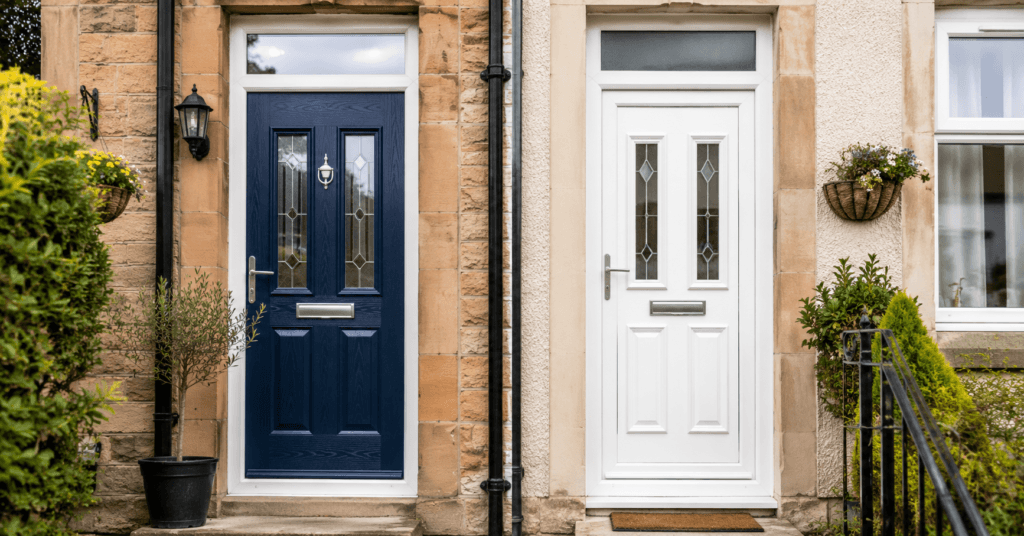
This is largely subjective, but composite doors are widely considered to look more premium. The GRP skin can be moulded to replicate wood grain texture convincingly, and they’re available in a much wider range of colours – including dual-colour options where the inside and outside can be different colours.
uPVC doors look clean and functional. Modern uPVC doors have improved considerably and can be attractive, but side by side with a quality composite door, the difference in perceived quality is visible.
For properties where kerb appeal matters – particularly semi-detached and detached houses on residential streets – composite tends to add more visual value.
Cost comparison
This is where uPVC wins. Typical installed prices in Scotland in 2026:
- uPVC door, fully fitted: £800 – £1,400
- Composite door, fully fitted: £1,400 – £2,500
The gap is real. For some budgets, uPVC simply makes more sense – particularly for rental properties, side or back doors, or situations where appearance isn’t a priority.
For a front door on an owner-occupied property where the homeowner will be living with the door for 15 – 25 years, the additional cost of composite often makes financial and practical sense.
Lifespan and maintenance
Both door types are low maintenance compared to timber. Neither needs painting. Both need occasional cleaning with a damp cloth and a light wipe of the moving parts with oil every year or two.
Composite doors are generally considered to last longer – 30 – 35 years is a commonly quoted figure versus 20 – 25 years for uPVC. The GRP skin is more resistant to UV degradation and discolouration than standard uPVC, which can yellow or fade in direct sunlight over time.
Which should you choose?
Choose a composite door if:
- It’s your front door and kerb appeal matters
- Security is a priority
- You want the look of timber without the maintenance
- You plan to stay in the property for a long time
- Energy efficiency and insulation are important
Choose a uPVC door if:
- Budget is the primary consideration
- It’s a side, back, or secondary door
- It’s for a rental property
- You want a practical, clean-looking door without the premium
Can I see both before deciding?
Yes – and we’d strongly recommend it. Seeing and handling both types in person makes the difference obvious in a way that photographs don’t fully convey. NuView’s Glasgow and Stirling showrooms have both composite and uPVC doors on display. You can open and close them, compare the weight and feel, and see colour and glazing options in person before making any decisions.
Visit our Composite Doors Glasgow page for more detail on our composite door range, or contact us to arrange a free no-obligation quote or showroom visit.
Frequently asked questions
Is a composite door worth the extra money?
For a front door on an owner-occupied property, usually yes. The improvements in security, insulation, appearance, and lifespan justify the premium for most homeowners who plan to stay in their property for more than a few years.
How long does a composite door last?
Typically 30 – 35 years with normal use and minimal maintenance. Most manufacturers offer a 10-year product guarantee as standard.
Can a composite door be painted?
No – and you won’t need to. The colour is moulded through the GRP skin, not painted on. This means it won’t peel, crack or fade in the way painted timber does. If you want a different colour at some point, you’d need to replace the door.
Are composite doors more secure than uPVC?
Generally yes. The construction is more resistant to forced entry, and most composite doors are fitted with higher-specification lock cylinders as standard. However, the quality of the lock cylinder matters regardless of door type – always check what cylinder is included in a quote.
Do composite doors warp or swell?
No. Unlike timber, composite doors are not affected by moisture, temperature changes, or UV exposure. They will not warp, swell, rot or require seasonal adjustment – one of the main reasons they’ve displaced timber as the premium door of choice.