Composite Doors Glasgow: The Complete Buying Guide
Composite doors have become the front door of choice for homeowners across Glasgow and Stirling – and for good reason. They look better than uPVC, perform better than timber, and outlast both. But with so many styles, colours, and suppliers to choose from, knowing what to look for before you buy is important.
This guide covers everything: what a composite door actually is, what affects the price, what to look for in terms of security and insulation, and how to choose a style that works for your home.
What is a composite door?
A composite door is built from multiple materials bonded together under high pressure. The outer skin is GRP – glass reinforced plastic – which gives it the look and texture of timber without any of the maintenance. Inside is a dense polyurethane foam core that provides excellent insulation. The frame is reinforced with steel or timber depending on the manufacturer, and the whole assembly is significantly heavier and more rigid than a uPVC door.
The result is a door that looks like solid timber, feels substantial when you close it, and outperforms both timber and uPVC on security, thermal efficiency, and longevity.
How much do composite doors cost in Glasgow?
Composite doors cost more than uPVC but less than aluminium or high-end timber. Typical installed prices in Glasgow in 2026:
- Standard composite front door, fully fitted: £1,400 – £2,200
- Premium composite door with side panels or bespoke glazing, fully fitted: £2,200 – £3,500
For comparison, a standard uPVC door runs to £800 – £1,400 fitted. The composite premium is real, but so is the difference in quality, security, and longevity.
What affects the price of a composite door?
Door style and panel design
A simple flush or lightly panelled door at the lower end of the range will cost less than a door with complex moulded detailing, decorative glazing, or feature sidelights. The more bespoke the specification, the higher the price.
Glazing
Most composite doors are available with a range of glazing options – from simple clear double-glazed panels to obscure, decorative, or leaded glass. More elaborate glazing adds to the cost but can significantly enhance the door’s appearance.
Colour
Standard colours – white, black, Anthracite Grey, Chartwell Green, Rosewood – are typically included in the base price. Some RAL colours or dual-colour options (different colours inside and outside) carry a small premium.
Hardware
The handle, letterplate, knocker, and cylinder lock are all variable. Upgrading to chrome, brushed steel, or gold-effect hardware adds to the cost but makes a visible difference to the finished look. Always check what cylinder is included – a Ultion or equivalent anti-snap, anti-pick cylinder should be standard on any quality composite door.
Security – what to look for
Security is one of the strongest arguments for choosing composite over uPVC. The dense construction – foam core, reinforced frame, GRP skin – is significantly harder to break through than a hollow uPVC door. Key things to check on any composite door:
- Lock cylinder: Look for a Ultion, Yale Platinum, or equivalent cylinder with anti-snap, anti-pick, and anti-bump certification. This is the most commonly attacked component in a door – it matters.
- Multi-point locking: All quality composite doors should have a multi-point locking system that engages at three or more points when the door is locked.
- PAS 24 certification: This is the enhanced security standard for doorsets. A door with PAS 24 certification has been independently tested to resist physical attack. Ask your installer whether the doorset – not just the door slab – carries this certification.
Insulation and energy efficiency
The polyurethane foam core of a composite door provides better insulation than the air cavity in a standard uPVC door. For Glasgow homes, where heating costs and cold winters are a real concern, this is a meaningful practical benefit. A well-fitted composite door with good perimeter seals should eliminate draughts entirely and contribute to measurable energy savings over time.
Look for a door with a low U-value – ideally 1.8 W/m²K or better. Most quality composite doors achieve this comfortably.
Styles and colours for Glasgow homes
Glasgow’s housing stock is varied – from traditional sandstone tenements and Victorian semis in the South Side and West End, to 1960s and 70s properties in areas like Pollokshields and Bishopbriggs, to modern new builds across the city. Composite doors are available in styles to suit all of them.
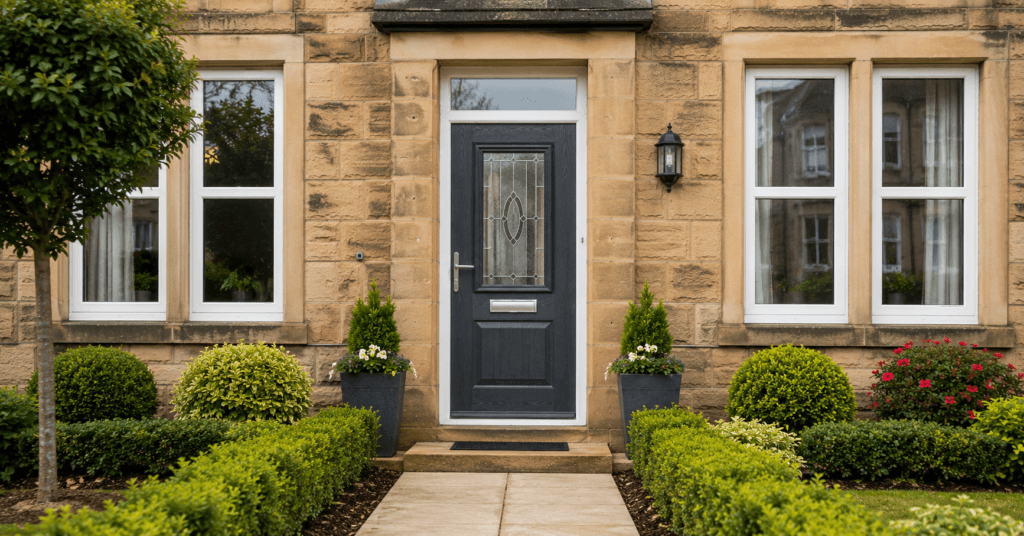
- For traditional sandstone properties: panel designs with timber-effect texture, in colours like Chartwell Green, Irish Oak, or Schwarzbraun, work beautifully with sandstone exteriors.
- For modern or rendered properties: flush or lightly detailed doors in Anthracite Grey or Black give a clean, contemporary look.
- For period properties: styles with decorative glazing bars, leaded panels, or heritage-style knockers and letterplates complement Victorian and Edwardian architecture well.
Dual-colour options – where the inside and outside of the door are different colours – are increasingly popular and add a considered, premium feel to the finished result.
See composite doors in our Glasgow and Stirling showrooms
The best way to make this decision is to see and handle composite doors in person. Photographs don’t fully convey the weight, the finish quality, or how different styles look at full scale. NuView’s Glasgow and Stirling showrooms have a wide range of composite doors on display, including multiple colour and glazing combinations.
Visit our Composite Doors Glasgow page for more on our range, or contact us to arrange a free no-obligation quote or showroom visit. We cover the whole of Glasgow and Stirling, with free home surveys available across both areas.
Frequently asked questions
How long do composite doors last?
A quality composite door should last 30 – 35 years with normal use and minimal maintenance. Most manufacturers offer a 10-year product guarantee as standard. The GRP skin is more resistant to UV degradation and discolouration than standard uPVC, so the door will still look good after decades of use.
Do composite doors need painting?
No – and this is one of their key advantages over timber. The colour is integral to the GRP skin, not painted on, so it won’t peel, crack, or fade the way painted timber does. Cleaning with a damp cloth a couple of times a year is all the maintenance required.
Can composite doors warp or swell?
No. Unlike timber, composite doors are not affected by moisture, temperature changes, or UV exposure. They won’t warp, swell, rot, or require seasonal adjustment. This is particularly relevant for Glasgow’s wet climate.
Are composite doors suitable for conservation areas?
Potentially – but you’ll need to check with Glasgow City Council’s planning department first. Some conservation areas allow composite doors; others require doors that more closely replicate original timber in terms of profile and detail. A reputable local installer will be familiar with the specific requirements and can advise.
What colours are composite doors available in?
The range varies by manufacturer, but most quality composite door ranges offer 20 – 30 standard colours including white, black, grey, green, red, blue, and a range of woodgrain effects including Irish Oak, Rosewood, and Schwarzbraun. Dual-colour options are available on most ranges. NuView can show you the full colour range in our showrooms.