How to Choose a Front Door: The Honest Guide
Your front door is one of the most visible and most functional parts of your home. It’s the first thing visitors see, the primary security barrier between your family and the street, and a significant factor in how much heat your home retains. Choosing the right one involves balancing several factors – material, security, insulation, style, and budget – and the right combination depends on your specific property and priorities.
This guide walks you through each of the key decisions clearly and honestly.
Step 1: Choose your material
The material your door is made from affects everything else – cost, performance, maintenance, and appearance. There are four main options for residential properties in Scotland.
Composite doors
The most popular choice for owner-occupied properties replacing a front door. Composite doors are built from multiple materials – a GRP outer skin, dense foam core, and reinforced frame – that together produce a door that looks like timber, outperforms uPVC on security and insulation, and requires virtually no maintenance. They don’t warp, swell, rot, or need painting. They come in a wide range of colours and styles. The downside is cost – typically £1,400 – £2,200 fitted for a standard front door.
uPVC doors
The most affordable option and a practical, low-maintenance choice for budget-conscious buyers, rear entrances, and rental properties. uPVC doors perform well thermally, are available in a wide range of colours and styles, and require minimal maintenance. They feel lighter and less substantial than composite doors, and the surface can discolour over time. Typically £800 – £1,400 fitted.
Aluminium doors
The premium choice for contemporary properties and applications where slim sightlines and large glazed areas are important. Aluminium is extremely durable, colour-stable, and available in a wider range of finishes than uPVC or composite. The cost is higher – typically £2,500 – £4,000 fitted for a standard front door – and the look is more contemporary than traditional, so it suits modern properties better than period homes.
Timber doors
Timber remains the classic choice for period properties, listed buildings, and conservation areas where regulations may require it. The look is unmatched, particularly in traditional hardwoods with quality ironmongery. The downside is maintenance – timber doors need periodic painting or staining and are susceptible to warping and swelling if not properly maintained. Cost varies considerably depending on the timber species and door specification, but quality hardwood doors with professional installation typically start at £2,500+.
Step 2: Prioritise security
Front door security breaks down into three elements – the door itself, the lock cylinder, and the locking mechanism. All three matter.
The door
A composite door’s dense construction makes it significantly harder to break through than a uPVC door. For maximum security, look for a door that carries PAS 24 certification – this means the complete doorset has been independently tested to resist physical attack.
The lock cylinder
The cylinder is the most commonly attacked component in a door break-in, typically through snapping. Always insist on a Ultion, Yale Platinum, or equivalent cylinder with anti-snap, anti-pick, and anti-bump certification. This should be standard on any quality front door – if it isn’t included in a quote, ask for it to be specified.
The locking mechanism
A multi-point locking system – which engages at three or more points along the door edge when locked – is essential. Single-point locks are significantly easier to force. All quality composite and uPVC doors include multi-point locking as standard.
Step 3: Consider insulation
A well-insulated front door contributes to the overall thermal efficiency of your home and eliminates draughts at the main entrance – a common comfort problem in older Scottish properties.
The key measurement is the door’s U-value – the lower the number, the better the insulation. Most quality composite doors achieve a U-value of 1.8 W/m²K or better. The perimeter seal is as important as the door’s core – a door that seals perfectly around its full perimeter will perform significantly better than the same door fitted with poor quality or worn seals.
Step 4: Choose a style that suits your home
Front door style should complement the character of your property rather than fighting against it. Some broad principles:
- Traditional sandstone or Victorian properties: panel designs with timber-effect texture in classic colours – Chartwell Green, Irish Oak, Schwarzbraun, navy blue – tend to look most appropriate
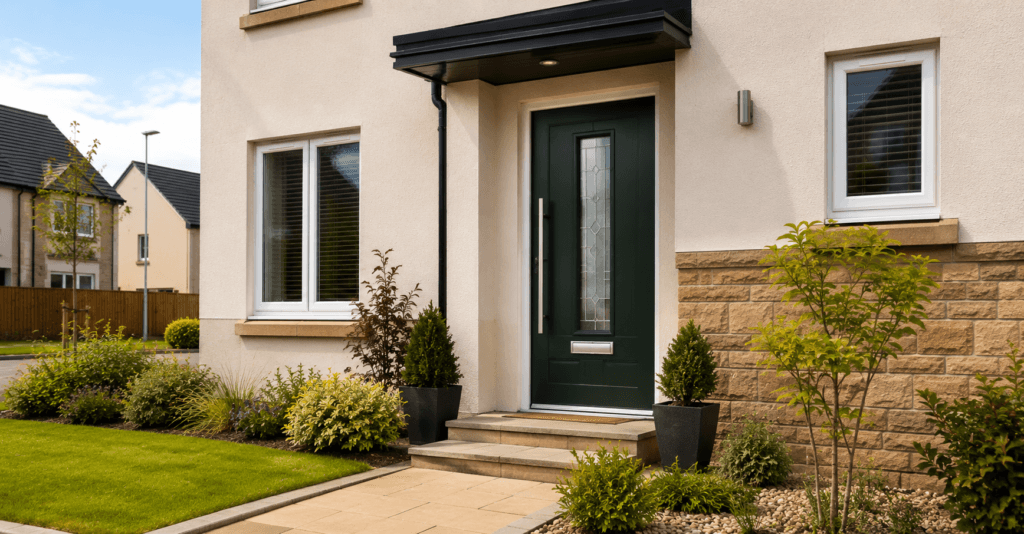
- Rendered or pebble-dashed properties: wider range of styles works well, including more contemporary flush designs and bold colours like Anthracite Grey or black
- Modern new builds: contemporary flush doors with minimal detailing in dark colours or aluminium tend to look best
- Period or listed properties: check with your local planning authority before committing to a style – some require specific materials or profiles
Glazing choices also significantly affect the finished look. Clear panels bring light into hallways but reduce privacy. Obscure or decorative glass balances light and privacy. Decorative glazing bars, leaded panels, and heritage-style designs suit period properties well.
Step 5: Think about colour
Colour choice is one of the most personal decisions in the process, but a few practical considerations help narrow it down.
Bold colours – navy, forest green, black, burgundy – make a strong statement and can significantly enhance a property’s kerb appeal. They work best on properties with clear, well-maintained exteriors where the door is a focal point rather than a detail.
Neutral colours – white, grey, cream – are more flexible and complement a wider range of exterior finishes. They’re also less likely to date.
Dual-colour options – different colours inside and outside – are increasingly popular and add a considered, premium feel without the commitment of a bold colour on the exterior.
See front doors in our Glasgow and Stirling showrooms
The only reliable way to make the final decision on style, colour, and material is to see doors at full scale in person. Photographs and samples don’t fully convey how a door looks, feels, and operates in real life. NuView’s Glasgow and Stirling showrooms have a wide range of composite, uPVC, and aluminium front doors on display.
Visit our Composite Doors Glasgow page for more on our composite range, or contact us to arrange a free home survey or showroom visit. We cover Glasgow, Stirling, and the whole of Central Scotland.
Frequently asked questions
What is the most secure type of front door?
Composite doors generally offer the best security for residential properties, combining a dense, hard-to-breach construction with high-quality locking systems. Look for PAS 24 certification on the doorset and a Ultion or equivalent anti-snap cylinder. The quality of the installation matters too – a well-made door fitted poorly is still a security vulnerability.
What colour front door adds the most value?
Research on this varies, but bold, well-maintained front doors in colours like navy blue, forest green, and black consistently perform well in estate agent surveys. The key factor is condition – a freshly painted timber door or a clean, unfaded composite door in any colour makes a better impression than a tired door in a supposedly popular shade.
Do I need planning permission to replace a front door in Scotland?
In most cases, no. Door replacement falls under permitted development for standard residential properties in Scotland. If your property is listed or in a conservation area, restrictions may apply to the materials and style you can use. Always check with your local planning authority before committing to a door if you’re unsure.
How long does a new front door last?
A quality composite door should last 30 – 35 years with normal use and minimal maintenance. uPVC doors typically last 20 – 25 years. Aluminium doors can last 40 years or more. The quality of the installation and the quality of the hardware – particularly the cylinder and hinges – significantly affects how long the door operates smoothly.
Can I see door styles in person before deciding?
Yes – and we’d strongly recommend it. NuView has showrooms in both Glasgow and Stirling where you can see composite, uPVC, and aluminium doors at full scale, handle the hardware, compare colours and glazing options, and get honest advice from our team. There’s no pressure to buy – the visit is purely so you can make an informed decision.