Listed Building Windows in Stirling: What You Need to Know
Stirling has one of the most significant concentrations of listed buildings in Scotland. From the medieval old town and the castle environs to the Victorian terraces of King’s Park and the historic streets of Bridge of Allan, a large number of properties in the Stirling area carry listed building status – often without their owners fully understanding what that means in practice.
If your home is listed and you’re thinking about replacing or upgrading your windows, this guide explains what the rules actually are, what you can and can’t do without consent, and how to navigate the process without falling foul of Historic Environment Scotland or Stirling Council’s planning department.
What does listed building status mean for windows?
Listed building consent is required for any works that affect the character of a listed building – and windows almost always fall into this category. This applies regardless of whether the windows are original or have already been replaced at some point in the past. It also applies to internal alterations in some cases, though windows are the most common point of contact between homeowners and the listed building consent process.
Critically, listed building consent is separate from planning permission. You may need both, or just listed building consent, depending on what you’re proposing. Carrying out works without the necessary consent is a criminal offence – not a planning infringement that gets regularised after the fact, but an actual criminal matter that can result in prosecution and a requirement to reinstate the original window at your own cost.
This isn’t meant to alarm you – the vast majority of listed building window cases are resolved straightforwardly, and sympathetic replacements are approved routinely. But the process needs to be followed correctly.
Categories of listed buildings in Stirling
Scotland uses a three-tier listing system administered by Historic Environment Scotland:
- Category A: buildings of special architectural or historic interest – the most significant, most restricted. In Stirling this includes the castle complex, the Church of the Holy Rude, and various other landmark structures.
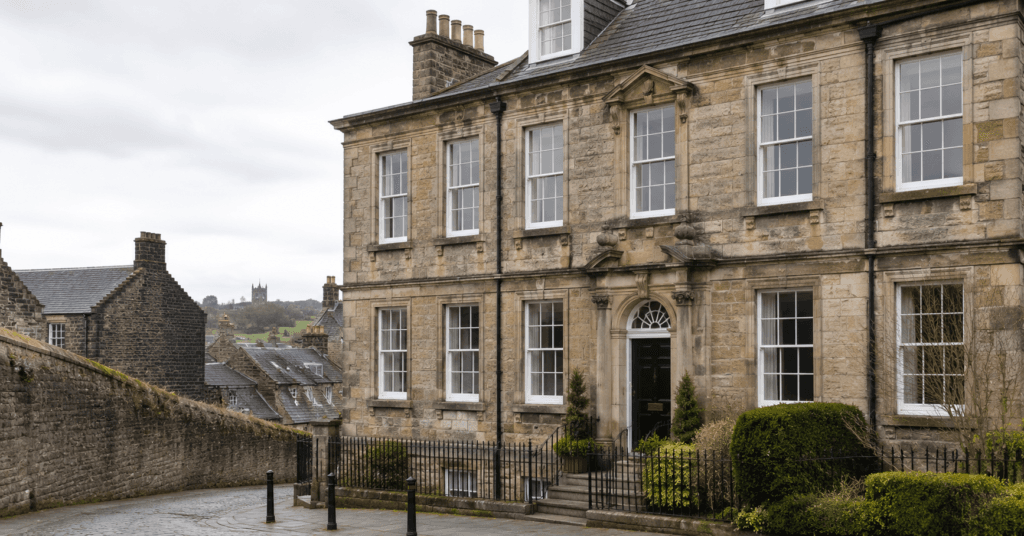
- Category B: buildings of regional or more than local importance. The majority of listed residential properties in Stirling fall into this category – Victorian terraces, Georgian townhouses, significant farmhouses.
- Category C: buildings of local importance. More flexibility is sometimes possible here, though listed building consent is still required for window works.
You can check whether your property is listed, and at what category, on the Historic Environment Scotland online database at historicenvironment.scot. If you’re unsure, Stirling Council’s planning department can also confirm status before you apply for anything.
What window replacements are typically approved in listed buildings?
The general principle applied by Historic Environment Scotland and Stirling Council is that replacement windows should match the original as closely as possible in terms of:
- Profile and proportion: the visual weight of the frame, the width of glazing bars, and the overall proportions of the window opening should be replicated
- Material: for Category A and most Category B buildings, timber is usually required – uPVC and aluminium are rarely approved for like-for-like replacements in the most significant listed properties
- Opening configuration: if the original window was a sash and case, a casement replacement is unlikely to be approved
- Glazing: secondary glazing is often preferred over replacement double glazing in the most sensitive cases, as it allows the original window to remain in place
For Category C listed buildings and some Category B properties, there is sometimes more flexibility – particularly where the existing windows are not original and have already been replaced at some point. Each case is assessed individually.
Secondary glazing as an alternative
Secondary glazing – a slim internal glazed frame fitted behind the existing window – is often the preferred solution for listed buildings where full window replacement isn’t permitted. It provides meaningful improvements in thermal performance and noise reduction without altering the external appearance of the building at all.
For Stirling properties where the external character is protected but the internal thermal performance is genuinely poor, secondary glazing is worth considering seriously. It’s not as thermally efficient as replacement double glazing, but in a well-fitted installation the improvement is real – and it doesn’t require listed building consent in most cases, though it’s always worth confirming this with Stirling Council before proceeding.
Timber windows for listed buildings – what’s involved
Where full window replacement is approved for a listed building in Stirling, the replacement is usually required to be in timber. Modern engineered timber windows are significantly better than their predecessors – more dimensionally stable, better sealed, and available with double glazing as standard – but they require more maintenance than uPVC or aluminium and cost considerably more.
For a traditional sash and case window in a listed Stirling property, expect to pay £1,500 – £3,500 per window for a quality engineered timber replacement with double glazing, fully installed. This is a significant investment, but for a listed building it’s typically the only route to consent.
The alternative – fitting uPVC or aluminium windows without consent – carries the risk of an enforcement notice requiring reinstatement at full cost, which would far exceed the saving made on the cheaper material.
How to apply for listed building consent in Stirling
Listed building consent applications are submitted to Stirling Council’s planning department. The process involves:
- Completing the listed building consent application form (available on the Stirling Council website and on the Scottish planning portal at eplanning.scot)
- Providing drawings showing the existing windows and the proposed replacement in sufficient detail – including sections through the frame profile
- A design statement explaining what you’re proposing, why, and how it respects the character of the listed building
- In some cases, a heritage impact assessment prepared by a conservation architect
The statutory determination period is eight weeks from validation of the application. Historic Environment Scotland is a statutory consultee for Category A listings and will provide comments on the application. For Category B and C, the decision rests with Stirling Council’s planning officers.
There is no application fee for listed building consent – unlike planning permission, it’s free to apply.
Pre-application advice
Stirling Council offers a pre-application advice service that allows you to informally discuss a proposed window replacement before submitting a formal application. This is strongly recommended – it allows you to get a steer on what’s likely to be acceptable before committing to a specific product or specification, which can save significant time and cost if the initial proposal is off the mark.
Conservation officers at Stirling Council are generally helpful and approachable for straightforward cases. The more information and the more clearly sympathetic the proposal, the smoother the process tends to be.
Working with an approved installer
Choosing an installer with experience of listed building work in Stirling matters. The right installer will be familiar with what conservation officers typically require, will be able to produce or advise on the drawings and documentation needed for the application, and will specify products that are appropriate for the listing category. An installer who isn’t familiar with the listed building consent process can inadvertently cause delays by proposing unsuitable products or failing to provide the right information with the application.
NuView has worked on properties across the Stirling area including period properties requiring careful handling. We can advise on what’s likely to be appropriate for your specific property and assist with the consent process before any work is committed to.
Visit our uPVC Windows Stirling page or our Stirling showroom page for more on our range, or contact us to discuss your specific property and what options are available.
Frequently asked questions
Do I need listed building consent to replace windows in a listed property in Stirling?
Almost always yes. Window replacement in a listed building affects the character of the building and therefore requires listed building consent from Stirling Council. This applies regardless of whether the windows are original and regardless of the listing category. The only exception is for like-for-like repair of individual components rather than full replacement, and even then it’s worth confirming with the planning department before proceeding.
Can I fit uPVC windows in a listed building in Stirling?
In most cases, no – particularly for Category A and B listed buildings where the external character is being actively protected. uPVC is generally not considered sympathetic to the character of historic buildings and is unlikely to receive consent for external window replacement. Timber is the material most commonly required. Secondary glazing internally is sometimes an alternative that avoids the need for listed building consent.
How long does listed building consent take in Stirling?
The statutory determination period is eight weeks from the date the application is validated by Stirling Council. In practice, straightforward and clearly sympathetic applications are sometimes determined faster. Pre-application advice can reduce the risk of delays by confirming what’s acceptable before the formal application is submitted.
Is secondary glazing a good option for listed buildings?
For many listed properties in Stirling, yes. Secondary glazing fits behind the existing window internally, improves thermal and acoustic performance meaningfully, and typically doesn’t require listed building consent because it doesn’t alter the external appearance of the building. It won’t perform as well thermally as full double glazing replacement, but for properties where replacement isn’t permitted it’s often the most practical route to improved comfort.
What happens if I replace windows in a listed building without consent?
Carrying out works to a listed building without the required consent is a criminal offence under the Planning (Listed Buildings and Conservation Areas) (Scotland) Act 1997. The council can issue an enforcement notice requiring the works to be reversed and the original windows reinstated, at the owner’s cost. In serious cases, prosecution can follow. This risk significantly outweighs any saving made by avoiding the consent process.