Bifold Doors vs Patio Doors: Which Is Right for Your Home?
When you open up the back of your home to the garden, two options dominate the choice: bifold doors and patio doors. Both flood a room with light and connect inside to outside, but they work in very different ways. Choosing between bifold doors vs patio doors comes down to how you use the space, how much of the opening you want to clear, your budget, and the look you are after. This guide compares them clearly so you can decide with confidence.
What is the difference between bifold doors and patio doors?
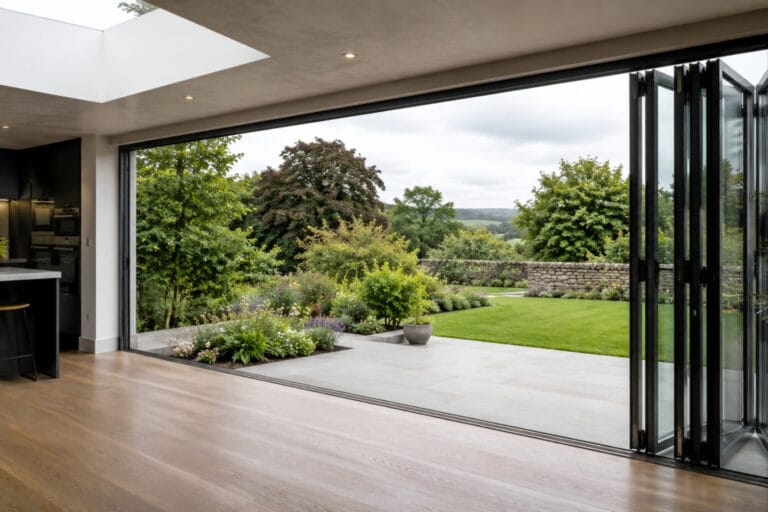
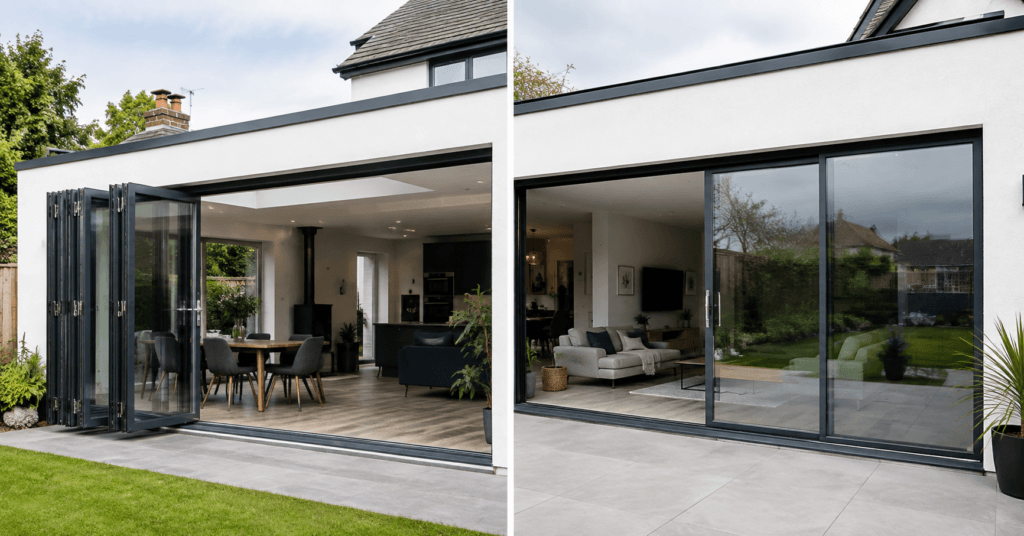
Bifold doors are made of several panels hinged together that concertina back on a track, folding to one or both sides to open up most of the doorway. Patio doors, in the sliding sense, have panels that glide horizontally past each other on a track, with one or more panels fixed. The core difference in the bifold doors vs patio doors question is how much of the opening each one clears, and how the panels behave when open.
How much of the opening does each one clear?
This is the biggest practical difference. Bifold doors fold right back and clear around 90 percent of the opening, giving you a wide, largely unbroken gap between house and garden. Sliding patio doors only ever clear the width of the panels that slide, so a typical two-panel or three-panel patio door opens roughly half the total width, because the sliding panel stacks against a fixed one.
If your priority is throwing the whole wall open on a summer day, bifold doors win comfortably. If you mostly want a large glazed view with easy in-and-out access rather than a fully open wall, patio doors do the job.
Which gives the better view when closed?
Patio doors tend to win here. Because they have fewer panels and therefore fewer frames, sliding patio doors give you larger, less interrupted panes of glass. That means a cleaner, wider view of the garden when the doors are shut, which matters through a Scottish winter when the doors stay closed for months. Bifold doors, with their multiple panels, have more frames breaking up the glass, though modern slim-profile bifolds have narrowed this gap considerably.
Bifold doors vs patio doors on cost
Sliding patio doors are generally the more affordable option. Fewer panels, fewer hinges, and a simpler mechanism keep the price down. Bifold doors cost more because of the more complex folding hardware and the greater number of panels and seals involved.
As a rough guide for Scottish installations, sliding patio doors typically start lower than an equivalent bifold across the same opening. That said, the price gap narrows on larger openings and higher specifications, so it is always worth comparing quotes for both across your specific opening.
Which is better for a small space?
Sliding patio doors are the stronger choice where space is tight. Because the panels slide flat against each other rather than folding into the room or out onto the patio, they need no clearance space to operate. Bifold doors need somewhere for the folded panels to sit, either stacking inward into the room or outward onto the patio, which uses up space at the edge of the opening. In a compact kitchen or a small patio, sliding doors keep everything clear.
Which suits the Scottish climate?
Both perform well when specified correctly, but there are nuances. Sliding patio doors have fewer joins and seals, which can mean fewer potential points for draughts over time, an advantage in exposed or wind-driven-rain locations. Bifold doors have more seals around each panel, so the quality of the hardware and installation matters more for keeping them weathertight. For either option in Scotland, look for a high weather-tightness rating and quality thermal breaks on aluminium frames.
Which should you choose?
Choose bifold doors if you want to open up the entire back wall, you entertain and want that indoor-outdoor flow, and you have space for the panels to stack. Choose sliding patio doors if you want the biggest uninterrupted glazed view, you are working with a smaller or more exposed space, or budget is a priority. Neither is simply better – they suit different homes and different habits.
The best way to decide is to see and operate both in person. NuView has bifold and patio doors on display at our Glasgow and Stirling showrooms, and our team will give you honest advice on which suits your specific opening. Explore our bifold doors in Glasgow and patio doors in Glasgow, or contact us to arrange a free survey across Glasgow and Stirling.
Frequently asked questions
Are bifold doors more expensive than patio doors?
Generally yes. Bifold doors cost more because of the folding hardware and the greater number of panels and seals. Sliding patio doors have a simpler mechanism and fewer panels, which keeps the price lower. The gap narrows on larger openings and higher specifications, so compare quotes for both across your exact opening.
Do bifold doors or patio doors give a better view?
Patio doors usually give a better view when closed, because fewer panels mean fewer frames and larger panes of glass. This matters through the Scottish winter when the doors stay shut for months. Modern slim-profile bifolds have narrowed the difference but still have more frames breaking up the glass.
Which is better for a small room?
Sliding patio doors are better for small spaces because the panels slide flat and need no clearance to operate. Bifold doors need room for the folded panels to stack, either into the room or onto the patio, which uses up space at the edge of the opening.
Are bifold doors or patio doors better for security?
Both are secure when specified with multi-point locking and toughened or laminated glass. Sliding patio doors have fewer opening panels, which can mean fewer potential weak points, while quality bifold doors use robust shootbolt locking across the panels. Choose either with a good locking specification and professional installation.
Can I fit bifold or patio doors in a Scottish tenement or period property?
Often yes, though period and listed properties may have restrictions on external alterations. Both door types can suit traditional and modern homes, but if your property is listed or in a conservation area, check with your local planning authority first. A survey will confirm what is possible for your specific opening.