How to Measure for Replacement Windows: A Simple Guide
If you are planning new windows, knowing how to measure for replacement windows helps you understand quotes and get a rough idea of sizes before an installer visits. It is a straightforward job to get an approximate measurement yourself, though it is important to understand from the outset that a professional survey is what your actual windows will be made from. This guide shows you how to take a sensible measurement and explains why the final measure should always be left to the experts.
Rather leave the measuring to us? Every NuView quote includes a free survey. uPVC windows start from £550 fitted including VAT. See our uPVC windows →
Why measuring accurately matters
Replacement windows are made to order for your exact openings. A window even slightly too big will not fit, and one too small leaves gaps that are difficult to seal properly, which is a real problem in the wind and rain of the Scottish climate. That is why accuracy is everything, and why every reputable installer sends a surveyor to take the final, precise measurements before anything is manufactured. Your own measurements are useful for planning and understanding quotes, not for ordering.
What you will need
To measure for replacement windows yourself, you only need a few things:
- A steel tape measure, which is more accurate than a fabric one
- A pen and paper, or your phone, to note the figures
- A step stool if the windows are high
- Ideally a second person to help hold the tape on larger windows
How to measure the width
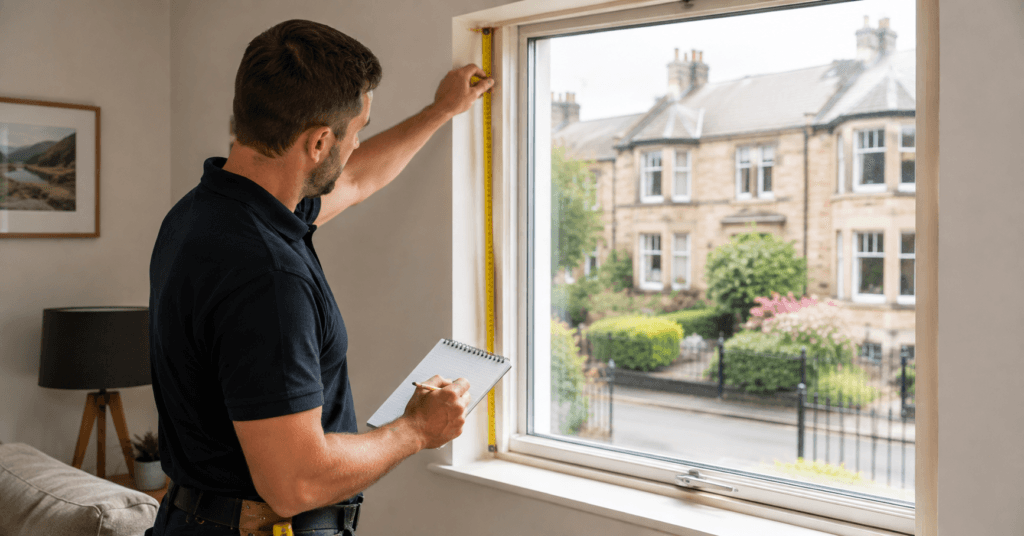
Measure the width of the window opening in three places: across the top, across the middle, and across the bottom. Openings are rarely perfectly square, especially in older Scottish properties, so these three figures may differ slightly. Note all three. When working out how to measure for replacement windows correctly, the smallest of the three width measurements is the one that matters, because the window must fit the tightest point of the opening.
How to measure the height
Measure the height in three places too: down the left side, down the middle, and down the right side, from the sill to the top of the opening. Again, note all three figures, and again the smallest measurement is the important one. Taking three measurements each way is the key habit that separates a useful measurement from a misleading one.
Measure every window individually
It is tempting to assume that windows of the same style are the same size, but never do this. Measure every single window separately, even ones that look identical, because openings settle and shift over the decades and can vary by surprising amounts. This is especially true in period and traditional Scottish homes where nothing is ever quite standard.
Why the professional survey is essential
Here is the honest truth about how to measure for replacement windows: your own measurements are a useful guide, but they should never be used to order the actual windows. A professional surveyor accounts for things that are easy to miss – the depth of the reveal, the condition and squareness of the opening, the fitting tolerances, sill details, and how the new frame will sit and seal. Because the windows are bespoke and non-returnable, the responsibility for the final measurements sits with the installer, and a good one will always survey before manufacture. This protects you completely: if a professionally surveyed window does not fit, that is on the installer, not you.
Get an accurate quote
Measuring yourself is a great way to get a feel for your project and understand your quotes. When you are ready for exact figures and a firm price, NuView provides free, no-obligation home surveys across Glasgow, Stirling and Scotland, with precise measurements taken by our own team. Explore our uPVC windows in Glasgow or uPVC windows in Stirling, or contact us to book a survey.
Frequently asked questions
Can I measure for replacement windows myself?
You can take a rough measurement yourself to understand quotes and plan your project, but you should never use your own figures to order the actual windows. A professional surveyor takes the final, precise measurements before manufacture, because bespoke windows are made to order and non-returnable.
Should I measure the width or the height first?
It does not matter which you measure first, but measure both in three places. For width, measure across the top, middle, and bottom. For height, measure down the left, middle, and right. In each case the smallest measurement is the important one, because the window must fit the tightest point of the opening.
Why do I need to measure a window in three places?
Openings are rarely perfectly square, especially in older Scottish properties where they settle over time. Measuring in three places reveals any variation, and the smallest figure is used so the window fits the tightest point. A single measurement can be misleading and lead to a window that does not fit.
Do identical-looking windows need measuring separately?
Yes, always. Never assume windows of the same style are the same size. Openings shift over the decades and can vary by surprising amounts, particularly in period and traditional homes. Measure every window individually, even ones that look identical.
Will the installer measure my windows before fitting?
Yes. Any reputable installer sends a surveyor to take precise final measurements before your windows are manufactured. The surveyor accounts for reveal depth, opening condition, fitting tolerances, and sill details. Because the responsibility for the measurements sits with the installer, this protects you if anything does not fit.
Once you have your sizes, see our uPVC windows → or book a free survey →